Friday, September 25, 2015

Diet and exercise, you say?

The past few weeks I have been eating...a lot...and it's all been pain free.  Since I have a loop ileostomy, the transit time is fairly short so food is not staying in my system for too terribly long.  And by that I mean, I eat some rice and maybe 45 minutes later I'm seeing pieces of rice in the bag.  This is common for people with loop ileos and can cause some weight loss, depending on your health and diet going into surgery.

I was at a healthy weight and five weeks into a mild/moderate flare-up just prior to my step 1 surgery.  The flare was caused by cessation of Remicade and 6MP usage in preparation for surgery, since it is my surgeon's strong preference that those drugs filter out of your system beforehand.  But the flare hadn't caused me to lose any weight, so I was a pretty healthy weight going into it.

Since surgery, I have lost about ten pounds.  I'm blaming this on the loop ileo, and I have made a concerted effort to have several high calorie snacks throughout the day since my goal is to stay at this weight, at least until my second surgery.  The standard post surgery diet is called the soft/low fiber diet.  It's actually not that bad!  Foods that thicken your output - bread, bananas, rice, applesauce, creamy peanut butter - are encouraged early on since your loop ileo will likely only produce liquid output initially.  

While I do miss raw veggies and fresh fruit, here are a few of my favorite foods for the first couple of weeks post-op:

  • Chicken soup:  I make my own broth from a roasted or rotisserie chicken, sautee celery and onions in some olive oil to soften them up prior to adding it (and cooking it into) the soup, and include rice or noodles to make this a well balanced meal in and of itself.  So comforting and delicious.
  • Egg salad sandwiches: Something I love, but never really think to make very often whatsoever.  Boil some eggs, chop them up and add mayo, and spoon it out over soft, white bread (NO seeds or wheat/grain bread!)
  • Bananas and avocados: Ok, I kind of lied about the fresh fruit thing.  I also don't eat bananas and avocados together, so I'm sorry if that created some confusion.  I love both, just separately, and they are 100% allowed.
  • Sweet potato biscuits:  I found these in the frozen food section of Fresh Market and I am totally hooked.  Made with real sweet potatoes so high in Vitamin A, it's rare that a day goes by without me eating at least one.  
  • Baked cod with lemon and butter:  I am a huge fan of fish and cod is an excellent source of lean protein.  Add a cup of salted rice and you have yourself a nice little meal.   
  • String cheese and crackers: I crave salt now - with good reason - and find this snack satisfies my salt tooth, provides a complex carb which helps thicken up output, and provides some delicious protein that's also fun to eat.  
  • Linguine Alfredo:  I found that the creamier the sauce, the better it got along with my GI tract (sorry ,tomatoes!  you're simply too acidic for me).  I like Classico brand since I was too exhausted to make my own.  
  • Chocolate milkshake with banana and peanut butter: This is one of the high calorie snacks I mentioned earlier.  A few generous scoops of Breyers chocolate ice cream, one ripe banana, and a couple tablespoons of creamy peanut butter.  Perfection.  
  • Yogurt:  I got in the habit of eating Blue Hill since they come in unique flavors, like beet and carrot.  Since they actually contain vegetable ingredients, its healthier than eating the sugar-packed run of the mill brands.  Delicious, as well as being a good source of protein and probiotics.


Also worth noting - I've been battling dehydration, so I drink a lot of water throughout the day, every day.  I'll add a nunn tablet to one or two of my glasses of water to help me get more electrolytes without any sugar.  I also have found that eating plenty of starchy, salty snacks like pretzels throughout the day helps thicken my output and stave off dehydration.

Exercise, like diet, is limited for several weeks after surgery.  The biggest challenge -- you can't lift anything heavier than 10 pounds for six weeks.  Also you are asked to wait at least four weeks before really starting to exercise like "normal people".  Luckily, walking is allowed from day one -- if you recall, I was determined to "walk" the evening after my surgery.  I doubt that walk in particular really paid off for me in any meaningful way, but I'd like to think that being determined to chase any opportunity to help the healing process will behoove you long term.  

I have made a daily habit of going for a walk first thing in the AM.  It's helped clear my head, keep me sane throughout this process, lets me stretch my legs and get some fresh air. There are of course more detailed scientific reasons as to how walking is good for you.  

I started off ridiculously slow.  In the hospital, I would walk 4 separate times a day along the perimeter of my floor.  One lap would take me about 10 minutes, which was the maximum amount of time I felt comfortable standing.

As soon as I got home, I was able to start steadily increasing my walks.  I am now at 3 miles a day -- broken up between one 2 mile walk and then either one 1 mile walk in the evening or two half mile walks.  It's been great to have this kind of structure built into the day and while I can't tell on a daily basis how much more my j-pouch is healing, I can measure progress by my walking mileage, and I've found that to be remarkably satisfying.  


Monday, September 21, 2015

Foreign objects

Before I left the hospital, I was told I would experience some slight anal discharge since the intestine used to form the j-pouch is alive and will do what live intestinal tissue does - produce mucus.  Since I've been at home, I've noticed a little discharge maybe every few times I sit down on the toilet to pee.  It's important to note that this only happens when I'm on the toilet; I have no discharge at any other time.  I was even told by my WOCN that a small amount of stool may pass as well.  

So, I shouldn't be concerned unless I see something alarming.

Well, after gently wiping one day, this is what I saw on the toilet paper...


Alarming, right?  It's a metal staple.  There was no blood accompanying it, but it was still disconcerting when a staple literally falls out of your body like that after a major surgery.  It's very small and I didn't feel it come out or anything.  I still called my surgeons nurse practitioner and she assured me it is common to see mucus, small amounts of blood, small amounts of stool, and staples when the stapling gun may have over-fired, essentially, if there was overlap on the stapling job and the top staple wasn't securely fastened into the bodily tissue.

Lesson learned:  there's nothing wrong with shitting a staple or two.


Sunday, September 20, 2015

The deal with the bag

My j-pouch blog wouldn't be complete without a post dedicated to one of the biggest unknowns going into this surgery - what will life be like with an ileostomy, or a "bag".  Yes, it's temporary but frankly, it still scared the shit out of me (bad pun - sorry :)  Until I learned that having the ileostomy is crucial for a good outcome and therefore an important part of the process.

When I started to research the j-pouch, I read a lot about two and three-step procedures.  I kept hoping I would come across a reputable colorectal surgeon who had a track record of successfully completing everything in a single surgery, thus eliminating the need for a temporary ileostomy.  This didn't happen, for good reason...

Once constructed, your j-pouch needs time to heal.  Think about it - you've just made a huge surgical alteration to the architecture and functionality of your digestive system.  The end of your small intestine has been folded over itself, stapled together, then stapled into place where your rectum was previously located.  To expect it to start functioning as a colon and rectum immediately (without leaking stool into the rest of your abdominal cavity) is asking a bit much.   

What I wish I had known before surgery is the ileostomy gets much better as time goes on.  My second day post-op at the hospital I was shuffling around my floor with my walker and the medical tech thinking I had been duped big time into believing people could live a reasonable lifestyle with a bag.  It was always full of liquid, it swung around as I walked and it was so heavy I felt like it was pulling my weakened abdomen to the ground.  It needed to be emptied frequently - you are supposed to empty it whenever it's one-third full, which is very often at the beginning.  It didn't help the overall situation when my medical tech started asking me inane questions like what was my favorite color (umm, I'm in my 30's, lady!) or if I have any children (do you ask your male patients that question?).

Anyways, the point is this - your body adjusts and for me it got better fairly quickly in the following ways:

  • Within days my output decreased and thickened up as my small intestine started to work a little harder by absorbing more water - previously a job handled by my colon.  
  • I got stronger and the abdominal incisions became less painful so that pull I felt in the very early days is now a non-issue.  
  • I was introduced to a variety of ostomy supplies that can greatly increase comfort - like the elastic belt that helps make everything feel more secure, stoma powder which is used on any irritated skin around your stoma, different types of wafers and bags that are opaque rather than the transparent ones they give you in the hospital, which is great because you don't want to have to worry about showing someone your poop every time your shirt goes up past your belt line.  


Here are the basic ileostomy supplies I've grown to love:
 Wafer - sticks directly on the skin like a giant sticker, fitted around the actual stoma
Opaque bag - clicks onto the wafer and has a velcro closure at the bottom to contain output
Barrier Paste - can either go directly on the skin around the stoma or on the inside edges of the wafer to prevent any output from seeping underneath the wafer
Sharp, curved scissors - for trimming the inside edges of the wafer so it best fits your stoma
Measuring tool - I'm told I won't need this in a couple of weeks when the size of my stoma stabilizes after the skin around it settles, but essentially this tool helps me cut an accurate size hole in the wafer for my stoma while it's still changing shape and size

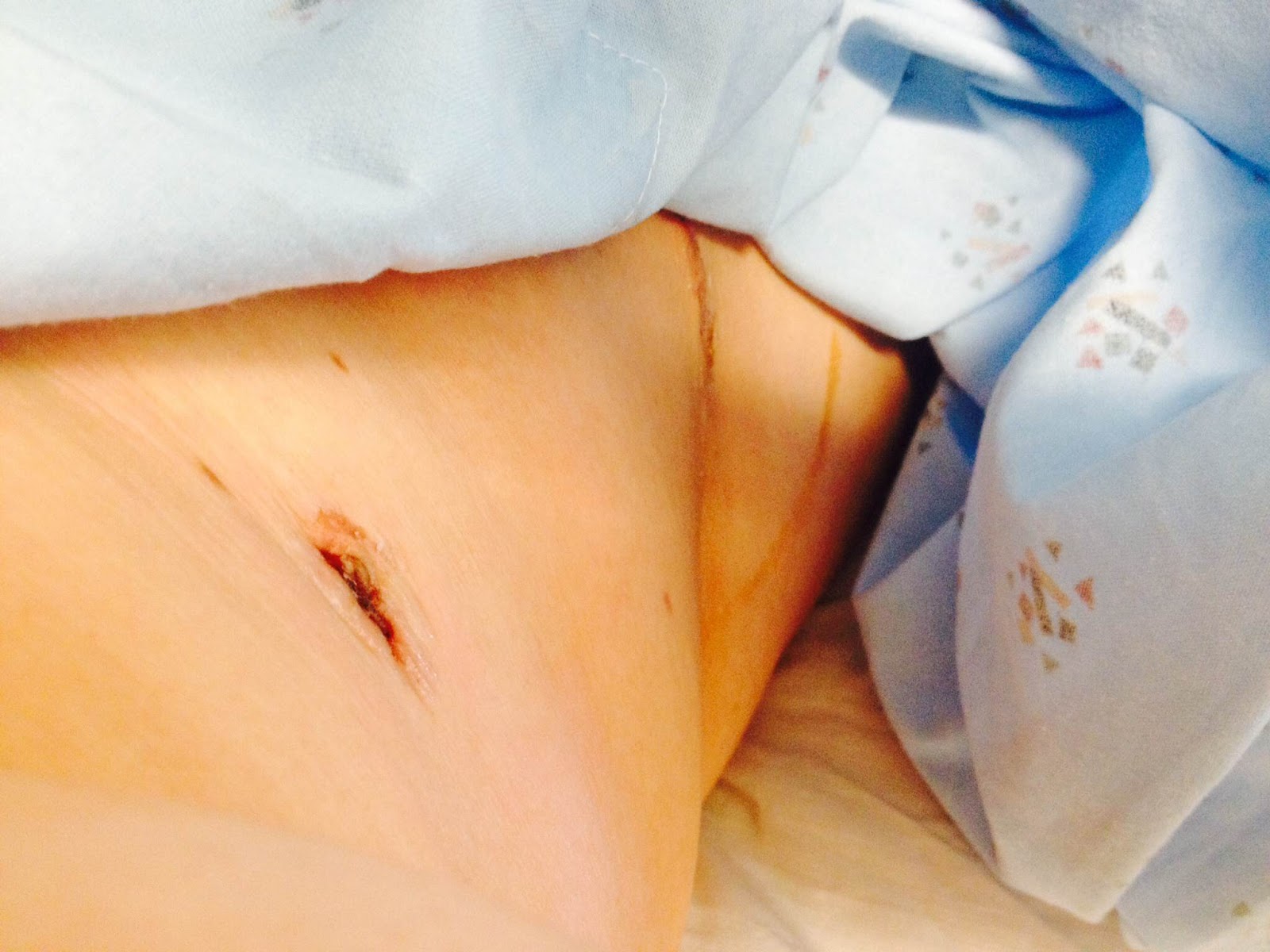
Here are some recent pictures of my abdomen, with and without a shirt on.  The drain site and laparoscopic incisions are scabbing up, the bruises from the heparin shots have faded a bit, the swelling on my tummy has improved and the bag and belt aren't obvious underneath a fairly thin camisole:


At this point I have had my ileostomy for nearly three weeks.  If you asked me now if you can live a reasonable lifestyle with an ostomy, my answer would be a resounding YES.  Even after yesterday, when I was combating dehydration - ok, before you judge that comment too harshly, you should know that dehydration for ostomates is a far more serious issue than it is for people who have a colon - I still feel that way.  I am able to do more with my ostomy than I could even imagine doing in the middle of a UC flare.  Emptying a pouch regularly and having control over when I go to the bathroom is a million times better than racing to the bathroom nonstop, obsessing over where the closest toilet is, wondering when the next hospitalization will be necessary, remembering when the next infusion is scheduled, worrying about the side-effects from your meds, asking yourself whether or not you'll be healthy enough to go on that trip in the future, dreading your next colonoscopy, etc.  You get the idea.  

Recently, I had a conversation with one of my best friends about the powerful ability we have to block bad experiences from our memory.  I can't tell you how many times I've shit my pants, come thisclose to shitting my pants, or had to abruptly leave a meeting at work or tell a coworker or friend to "HOLD THAT THOUGHT!" while they were mid-sentence so I could actually make it a toilet on time and proceed to shit blood, doubled over in pain.  The other day my friend reminded me of a time we were walking back to our apartment building from the gym early one morning and I had to find the best place to take a crap outdoors because I knew I couldn't make it back to my apartment in time.  Who likes making those kinds of decisions?  Interestingly, my friend had to jog my memory (and the puns keep on comin'!) before I was able to recall it on my own.  I conveniently blocked this event from my mind.  I could rationalize this behavior by saying if we obsess over or even occasionally rehash these instances, it can be a real downer.  But I think there's a thin line between being super positive and being in denial. 

When it comes to the bag or severe UC, the bag wins every time.   


Tuesday, September 8, 2015

Where are they now? My one week post-surgery update.

I can't believe it's been a week since the completion of my step one J-pouch surgery!  I'll share the highlights of this past week below.  If you are not into suspense and want to know the answer to Where am I now, I am actually on a deck overlooking the beach, sitting under an umbrella.  There have been many ups and down this past week, but overall, I am doing fine and feeling good.


In case you aren't already aware of what step one of two entails, the purpose of this surgery is the following:

1.)  Remove my entire colon, appendix (a casualty of any colectomy) and rectum

2.)  Construct a j-shaped pouch out of the end of my small intestine

3.)  Staple this internal pouch to a small rectal cuff in my anal canal

4.)  Create a temporary loop ileostomy 

All in a days work, right?  My surgery was robot-assisted laparoscopic and took over 6 hours from start to finish.

Once I woke up in recovery, I wanted answers!  I asked my recovery nurse if surgery went ok, if they constructed the pouch, how many incisions I had, if I had any large incisions, if there were any surprises during surgery, etc.  In hindsight, I doubt this person was even in the OR with me and therefore questionably qualified to provide accurate answers, but nevertheless, I seemed satisfied with whatever she told me, or was just so zonked out from the pain meds that I drifted back to sleep.  

I woke up more once I was situated in my hospital room.  My nurse asked me what I would like for dinner.  What?  I can eat?  Yes.  I was on a low fiber/soft diet.  I had zero appetite, but ordered cranberry juice, water, ice, saltines and cottage cheese.  While "dinner" was on it's way, she asked me if I would like to go for a walk.  I read up on how important walking is so I jumped (metaphorically speaking) at the chance to get a walk in so quickly. 

My distance of my first walk was fifteen feet, MAYBE.  After the nurse secured my catheter and drain, unhooked my IV stand from the wall, and set up the walker to be the appropriate height for me, I was already exhausted.  While standing up, I started to really notice how sore my body felt.  As someone who has a high pain tolerance and a pretty positive attitude, I want to make this point super clear - despite whatever pain medication I was on, I was still in pain.  Everything hurt, especially my abdomen and shoulders.  Breathing, moving, not moving, whatever.  It was a strong, constant, aching pain.  I have never felt anything close to it before.   Since I was up and felt this walk was absolutely necessary, I went ahead and walked (read: slowly shuffled) with my nurse out of the room and across the hall using my walker, only to turn right back around and call it a night.  

Back in bed, I lifted my hospital gown and looked at my abdomen.  On the right I saw my ileostomy, a 1/2" incision at my hipbone and maybe a 1/4" incision at my lowest rib.  In the middle I saw my belly button had surgical glue in it, and I could see a couple of dark stitches on the very top.  On the left, there was one 1/2" incision about an inch under my ribs and a drain sticking out of my left side (basically a tube connected to a clear, plastic ball filled with blood.  


I sipped cranberry juice and ice water which tasted great and actually ate three saltines and two spoonfuls of cottage cheese.  I expected nausea, vomiting, something bad but nothing.  Dark liquid began coming out of my stoma but I was assured that everything looked normal.  
I fell asleep.  Day 1 was over.  

I stayed in the hospital for three more days.  Two and a half, really!  During this time, I slept a lot, my catheter was removed, my drain was removed (they waited for the very last day to take this out), my ileostomy bag was changed twice - once with the rod my surgeon inserted to prop up my loop ileo and once without, so my loop ileo surgical rod was also removed, I started eating more from the low fiber/soft diet (more on this later), I showered with a lot of assistance from my nurse, I was set up with a home WOC nurse who would be visiting me once I was settled back home, I walked more and perhaps most interesting - I learned that during surgery they pulled my colon out through the tiny incision made inside my belly button.  Pretty amazing.  

But far and away, the best news came on my last day in the hospital.  My pathology report came back with no surprises.  UC diagnoses was confirmed, no signs of Crohn's disease or cancer.  I teared up from relief and happiness.  My decade plus struggle with UC was over.  Although I didn't think I had Crohn's (or cancer), there's nothing like receiving a pathology report back, post colectomy, that states this news because inflammatory bowel diseases are  poorly understood.  Misdiagnosis isn't extremely infrequent and is always a possibility.  No more UC - thanks surgery! - no Crohn's, and no cancer!  Time to celebrate with a little apple juice.  

The past several days at home have gone well.  I am in awe at how my body is recovering and how good I feel given everything my body underwent a mere week ago.  Perhaps it's thanking me for ditching my diseased colon.  I've gotten a little more used to having zero abdominal strength and have perfected the motion of literally rolling out of bed.  I go for regular walks, I drink a lot of water, I practice a TON of patience with myself, I am honest as it relates to my physical limitations these days.  While I'm sure there will be more obstacles in the coming days, weeks and months, I am very fortunate and proud of where I am right now.  


Friday, September 4, 2015

Things are going to get worse before they get better...

...is what I kept telling myself on Sunday night, during the last bowel prep of my life (yay!).  

I've lost count over how many bowel preps I've done over the years, but it has been a lot.  I made the mistake of thinking my pre-op bowel prep would be like any other.  What made this one different is the short course of two different antibiotics - 12 pills total - that were prescribed during the prep to stave off any intestinal bacteria that could be problematic if/when spillage occurs during surgery.  (You're welcome for that imagery!) And if you've ever taken antibiotics on an empty stomach then you probably can understand the pain and nausea that accompanied my pre-op party with my colon.

Needless to say, Monday morning couldn't come soon enough.  I arrived at the hospital at 6:30am, was processed quickly and put into an OR prep room, where I changed into a hospital gown, got hooked up to an IV, talked to the nurses and anesthesiology resident.  I got this, I thought.  Then as soon as they left the room, I completely freaked out.  Of course three seconds later my surgeon arrived to say hello and check in.  He reassured me that pre-op anxiety is extremely common and helped calm my nerves.  I took several deep breaths.  The last thing I remember was being rolled into the OR, fascinated by all of the equipment and special lights and people in the room.  Then I drifted off to sleep.    

Saturday, August 29, 2015

Pre-op post

Yesterday was pre-op appointment day!  Everything went very smoothly and I credit this to the quality of the hospital where I am having my surgeries.  

One consistent tip from researching j-pouch surgery was to select the most experienced surgeon you can find.  I interviewed two local surgeons but decided after our consultations, that I may have to travel to find the right one.  Although this automatically makes this process more difficult from a logistics standpoint, I am happy (so far) with my decision.  My surgeon has performed almost 1,000 j-pouch procedures and is one of the main j-pouch surgeons at a top hospital in the US.  People have traveled as far as Saudi Arabia to have him operate on them.  His success rate is 99%.  


The pre-op itinerary went a little something like this:

1.) Registration - confirmation of insurance (your insurance company will need to pre-approve surgery and this approval is initiated by the hospital, so I just received a letter in the mail a couple of weeks ago to let me know I was good to go), ID, and providing a copy of a living will.  

2.) Lab time - standard blood and urine tests

3.)  Meeting with the surgeon - the purpose of this meeting is to go over any remaining questions and sign paperwork.  My first surgery is scheduled on Monday and is considered the "bigger" of the two - total proctocolectomy with internal jpouch creation and temporary diverting loop ileostomy.  After this surgery, and several follow-ups, I will have the reversal or takedown surgery scheduled.  Likely the surgeries are three months apart to allow my jpouch to heal.  Since I mulled over this surgery for YEARS, talked to numerous j-pouchers and surgeons and GI doctors, met with this specific surgeon already two times and researched this procedure for hours on end, I really didn't have any remaining questions for him.  I was ready.

4.)  Meeting with the wound,ostomy, and continence nurse - my meeting with the WOC nurse was awesome.  Patient, kind, and down-to-earth.  She showed me the standard supplies: barrier ring, wafer, ostomy bag, clip. She had me lift my shirt and pull down my shorts a bit so she could choose my stoma site.  Before she started drawing, I stood, sat, and laid down so she could choose the best place for it.  Then she marked my stomach, just below and to the side of my belly button, with two large black dots - one on my right (your left if you were facing me), where my stoma would likely go, and one on the left, "just in case".  

We also talked about the loop ileostomy and how it's different from an end ileostomy.  She also warned me that I will have a small plastic rod that will help prop up the loop, but this rod will only be in place for a few days after surgery.  I will see her the day after my surgery so she can perform my first appliance change.  

5.)  Pre-op evaluation - since I am fortunate enough to not have any other major health issues and I'm relatively young, this was a quick evaluation.  The nurse practitioner took my vital signs, listened to my heart and lungs, talked to me about my medical history, and asked me about my current medications.  Oh yeah, current meds...I am on NO meds right now.  Since I was in quasi-remission when I scheduled my surgery and in pretty good shape, my surgeon asked that I stop all biologics and immunomodulator medications for 6-8 weeks prior to surgery.  This of course means that for the past 6 weeks I have been in a flare and my hemoglobin is low, but other than that, I checked out just fine.  


Next up: my last ever bowel prep tomorrow and surgery on Monday!

Friday, August 28, 2015

11 years a slave (to UC)

Yes, the title is a bit dramatic but I thought it might be helpful to share my history with this disease, so here it goes...

I started experiencing symptoms the summer before my senior year in college.  The first thing I noticed was blood whenever I went to the bathroom and, honestly, I didn't give it a lot of thought.  Sure, it was weird, but probably something completely benign.  Why would it be anything major?  I ate healthy, exercised, drank plenty of water, slept a lot, and was only 21 years old.  Plus, I never got sick!  I remember confiding in a close friend and she joked that my stomach was getting back at me for feeding it so much salad.

The internal bleeding persisted and I developed the other lovely symptoms characteristic of UC - frequent, urgent diarrhea, fatigue, discomfort - so, my mom insisted that we schedule a visit with a local GI.  The appointment was quick; the doctor said I "looked good" (mind you, she did not examine my GI tract; this assessment was made after glancing at me while I was fully clothed) and could fit me in for a December colonoscopy when I was back in town from college if my symptoms continued.  

No big deal, right?

Wrong.  I went back to school and attempted to continue to live a normal life, which for me  meant running cross country, going to frat parties and taking on a full course load across a very hilly, spread out campus.  My cross country coach was stumped as to why I could not keep up.  I was quickly dropping weight.  I could not focus during class; my mind was always drifting to my symptoms.  My head was throbbing due to all the blood loss and I was frequently dizzy and out of breath.  I had been modifying my eating schedule to avoid accidents, sleeping every chance I got to preserve energy, all the while thinking if I could just hold out until December, my GI would figure out what was wrong and treat it.  But in the meantime, I needed to get through this semester.

Well that plan came to an abrupt halt when I fainted while crossing the street on my way home from class.  Luckily my friends were nearby and somehow got me to the ER.  After drinking what felt like several gallons of golytely, undergoing a colonoscopy, and getting a blood transfusion (which finally helped me instantly feel a lot better since my hematocrit was in the low teens!), the GI broke the news that I had Ulcerative Colitis, a chronic inflammatory bowel disease.

The plan was to manage my symptoms using a steroid called prednisone and an anti-inflammatory drug called asacol.  I would only be on prednisone for a month and then begin to taper, since immediate cessation of steroids can screw up your adrenal glands and staying on the drug long-term can cause serious damage.  I could not wait for this month to be over.  Although prednisone quickly got my symptoms under control, I was very "roid ragey" as my housemates would attest, had trouble sleeping, my joints were killing me, and I developed what is known as moon face.  I would stay on asacol as my maintenance drug of choice.  

Once off the prednisone, I started to experience symptoms again, so I was instructed to bump up the asacol to the point where I was taking 12 pills a day.  But, it worked for me, so I accepted that reality and went about my life.  For about two years...

Then symptoms came roaring back.  This time I was taking rowasa enemas on a nightly basis, put on prednisone again, didn't respond quickly enough, and had to trade the Europe trip I planned with a friend for a 7 night stay in a shared room at the hospital.  I was pumped full of steroids and antibiotics, underwent another colonoscopy, received another blood transfusion.  This time as I was tapering the prednisone, continuing to take asacol and doing rowasa enemas every night and canasa suppositories every day, I was also given a prescription for mercaptopurine (aka 6MP), an immunomodulator drug formerly used as chemotherapy for cancer patients.   

This new (for me) med is designed to suppress your immune system and it is metabolized in the liver, so regular, on-going blood tests were needed to make sure my liver wasn't getting aggravated.  I was also told that I needed to have colonoscopies every year, whether or not I was flaring, to effectively monitor and treat my disease.  It was around this time when I started to feel a bit overwhelmed and curious as to what my life would be like with this disease long-term.  Although I did my best to hide it, I felt like I was already sacrificing enough to live as normal a life as I could.  I asked my doctor about surgery - up until then, it was mentioned in passing, like it was something I was SO far from wasn't even worth discussing - and my GI basically dismissed the conversation, urging me to take the 6MP.  

Truthfully, life on 6MP wasn't bad.  I could tell my skin was more sensitive to the sun and I didn't love having to go to the lab regularly for blood tests, especially because I am a difficult stick.  I have to give the drug credit though - it kept my UC in check for several years.  Then it became obvious that 6MP alone wasn't enough when I started a year and a half long flare which of course meant more of the same stuff - hospital stays, rectal meds, prednisone, IV steroids, colonoscopies, blood transfusions, etc.  After the scariest hospital stay of my life -   I was admitted after being non-responsive to four weeks of steroids and finally started to see slight improvement after 7 days in the hospital and being bumped up to the max dosage of IV steroids - it was now time to start layering on a biologic drug to my 6MP usage.

My first choice was Humira because I was under the impression that it would be more convenient for me.  A quick self injection in the comfort of my own home versus the 4 hour remicade infusion at the hospital made it seem like a no brainer.  But my loading doses were painful, my resulting headache extreme, and frankly, the drug didn't put a dent in my symptoms.  

My GI had me start remicade which started to work.  Again, until it didn't.  When my symptoms flared up again despite being on 6MP, remicade, and rowasa enemas, AND I developed remicade-induced psoriasis which made my face look and feel like sandpaper despite numerous topical creams prescribed by my fancy dermatologist, I knew it was time for surgery.  I could try two other biologics on the market - simponi and entyvio - but honestly, I'm tired of the medication roller coaster.  I've also noticed that over the years my flares have gotten increasingly more severe and when your body is not responding to constant administration of all drugs available and the highest dosage of steroids the medical community feels comfortable giving you, it starts to get scary.  Even as you recover from that kind of flare, you can't help but wonder when the next one will come about and if an emergency colectomy is in your future.  I'm ready for what I believe will be a better, more permanent solution for me.  

So, here I am!

Monday, August 24, 2015

Welcome

Hi all.  I'm 32 years old and I have Ulcerative Colitis (UC).  After trying (and failing) to manage my disease with various medical therapies, I've decided to undergo surgery.  I am scheduled for a robot-assisted laparoscopic proctocolectomy with ileal pouch-anal anastomosis, also referred to as j-pouch surgery.  

Many people have shared their experience with this surgical treatment through similar blogs, and because of them, I feel more knowledgeable and confident going into this procedure. So, I want to thank those people and share my experience as well.  Hopefully my unfiltered account will serve as a helpful resource; in case you need to say a final FU to your UC, too.